
“Time to drop the really big bomb…”
Elon Musk’s June 2025 social media fallout with Donald Trump knocked $152 billion off Tesla’s value overnight, personally costing Musk $8.73 billion.
But this is nothing compared to the $770 billion market cap plummet that followed Tesla’s record $1.5 trillion valuation a month after Election Day.
Musk’s choice to support the Trump campaign and then become a de facto member of the administration had implications for his businesses, his wealth, and the American people. It was only the latest turn in a long on-off relationship with Donald Trump and the American government.
From hundred-million-dollar government handouts to his influence in the White House, Musk’s personality and relationship with the Trump administration had a rollercoaster effect on Tesla stock. And every American has a stake in the outcome.
The team at NeoMam Labs used historical share data to explore how Tesla’s value in the stock market and at the used car showroom has changed in response to Musk’s big statements over the years.
| Key findings: |
|---|
| → Tesla shares rose 238 times over between going public in 2010 and the dawn of Trump 2.0 in 2025, from the equivalent of $1.59 to $379.28. → In 2024, Tesla’s market cap rose 77.5% from pre-election levels to $1.42 trillion — almost halving again by April 2025. → The price of a used Cybertruck fell 11.4% between Election Day and the inauguration. → In 2025, Tesla recalled 80.6% fewer vehicles than it had averaged over the previous three years. |
We hope this project will make it easier for members of the public to quickly share trustworthy facts, reducing the level of disinformation and misinformation on the subject that is likely to dominate 2026.
| What we did: |
|---|
| We sourced Tesla’s stock price history and manually researched the events surrounding the dates of the biggest stock dips/rises since Tesla went public. We also retrieved Tesla’s historical market cap alongside its major competitors to trace its ups and downs. Using average prices by week from CarGurus, we explored how Tesla used car prices have changed compared to those of its competitors since the 2024 election. And finally, we recorded and charted the total number of Tesla vehicle recalls by year using government figures. > Note on share prices: Tesla has split its original shares into 15 shares since its initial public offering. To keep things consistent, we refer to the split-adjusted prices throughout this article. |
Going public: the power of Musk’s voice as Tesla began selling shares
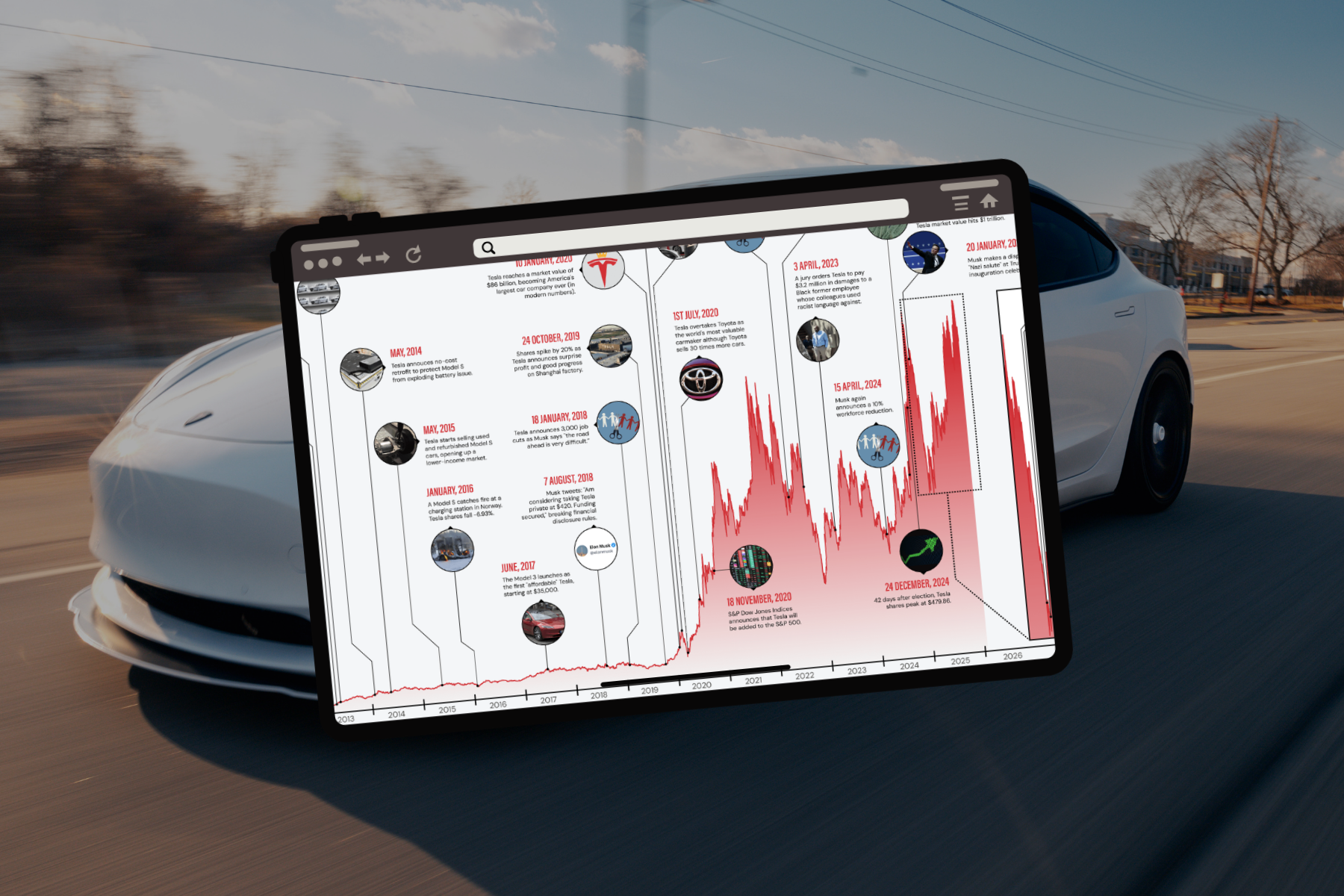
Visualizing the history of Tesla through its stock price
June 29, 2010: Obama was President, the iPad was just six months old and Grimes’ first album was in the shops – in Canada, at least.
At this point in time, Tesla had sold just 1,063 motor vehicles. The company had lost $55.7 million the previous year and $260.7 million altogether despite a $465 million loan from the U.S. government in June 2009. Musk personally claimed he “ran out of cash” by pumping his annual income back into the company.
That was the day that Tesla Motors went public — the first car maker to do so since Ford in 1956 — issuing 13.3 million shares at $17.00. Tesla has since split those shares into fifteen even shares each, so to keep things consistent, we’ll refer to the split-adjusted prices throughout this article. In those terms, Tesla opened trading at $1.13, but demand was so high that Tesla stock closed the day 40% higher at $1.59.
After that, growth was slow. But Tesla did have a unique selling point: it made electric cars sexy. And, it had a frontman who got them into the headlines. Tesla wouldn’t spend a penny on traditional advertising until 2023, when it was already a half-trillion-dollar company.
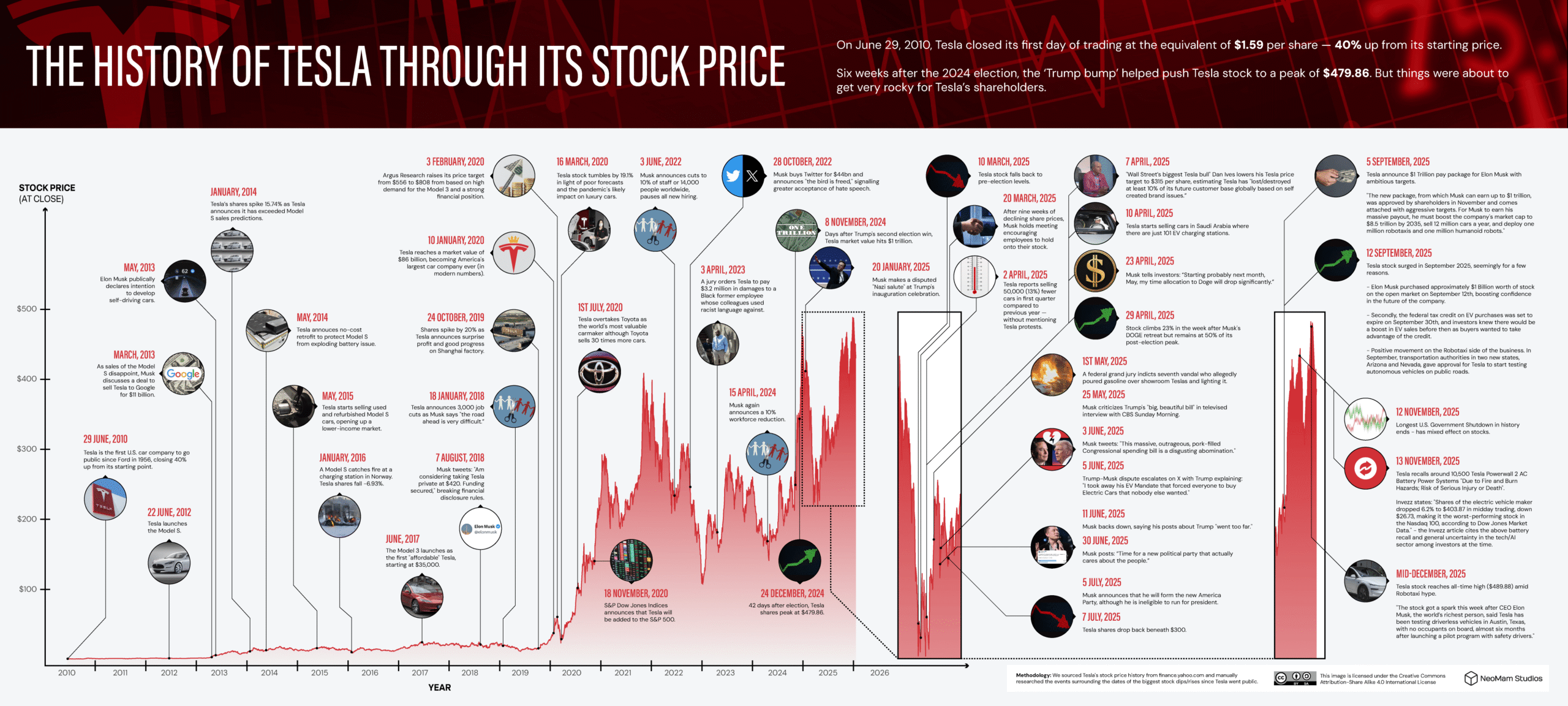
Like many buzzy start-ups, Tesla faced scrutiny as to the substance behind the hype. Its public offering was premised on the launch of the Model S, which was still at the design stage with no factory or manufacturing process ready to build it and a delivery date of 2012. Still, as anticipation for the Model S grew, so did the stock, closing at $2.25 on Model S delivery day, 18 months later: June 22, 2012.
“In 2009, we set out to build the most innovative car of the 21st century,” Musk declared, “and since then have dedicated ourselves to developing and testing Model S to ensure that under any situation, Model S never disappoints.” He was wrong. The Model S was riddled with glitches and missing features. A series of fires linked to the battery gave potential buyers the jitters. Many who had pre-ordered a car had yet to receive it.
“If we don’t deliver these cars, we are fucked,” Musk told his team as shares sank to just $2.47 by the following February. “So I don’t care what job you were doing. Your new job is delivering cars.” In public, he promised customers that Tesla would refund the difference if their Model S didn’t hold its resale price compared to the Mercedes-Benz S Class: “Even if Tesla is unable to honor it, I will personally do so,” he told reporters. “That’s what I mean by putting my money where my mouth is.”
But after cutting production time and delivering the missing cars, Tesla began to benefit from positive word of mouth. Sales soared, and Musk pulled out of a secret deal to sell Tesla to Google for $11 billion.
After announcing Tesla’s first ever profitable quarter on May 8th, share prices doubled in less than three weeks — and Tesla was on its way.
Building value: Tesla market cap wobbles as Musk shares feelings
Visualizing how Tesla’s valuation compares against rivals over the years
Tesla’s market cap was expected to rise at pace through 2013. And by fixing its designs and its relationships, Tesla became America’s most valuable car maker in April 2017, overtaking GM Motors to reach a market cap of $51.54 billion. But the fastest growth was yet to come.
The company raked in $1.6 billion in regulatory credits alone in 2020 as other carmakers paid Tesla to offset their own greenhouse gas emissions, and Tesla sales rose by 36% to just under half a million cars that year. It became America’s most valuable carmaker ever (not allowing for inflation) in January 2020, and the world’s most valuable carmaker in June 2020. From January 2018 to December 2020, Tesla’s market cap value rose nearly ten times over to $567.83 billion.
You can see how this acceleration in 2013 and 2020 affected Tesla’s relative market position in the animated bar chart race below.
But as Tesla’s fortunes soared, the cracks in Musk’s persona were beginning to show. In 2018, Musk and Tesla were fined $20 million each after Musk fraudulently tweeted his plans to take Tesla private, inflating Tesla’s stock price by more than 6%. Musk later tweeted that the Like ratio of the $20 million tweet was “Worth it.”
In May 2022, Tesla was booted off the S&P 500’s ESG Index for its “codes of business conduct.” The brand wobbled and Warren Buffet-backed Chinese EV firm BYD overtook Tesla in sales of electrified cars (using figures that included BYD’s hybrid cars; for purely electric cars, BYD would overtake Tesla in 2025).
In October, Musk bought Twitter for $44 billion, later renaming it X, but his increasingly intolerant rhetoric motivated advertisers to abandon X in droves. When telling those advertisers to “Go. Fuck. Yourself.” failed to bring them back, he finally went back on his “no advertising” mantra, plugging the gap with hundreds of thousands of Tesla’s dollars for X adverts that deliberately evoked Musk’s terse, fragmentary posting voice.
As 2024 unfolded, things didn’t look much better for Musk or Tesla. In January, a Delaware judge vetoed Musk’s $56 billion Tesla pay package. Tesla shares fell by 35% during the first quarter as the market cap lost nearly $230 bn; and net income sank by more than half (55%) in the second quarter as BYD flourished in China.
In July, Musk went back on his statement that he would not endorse a U.S. presidential candidate, pledging his support to Donald Trump. It was to change the fortunes of both Tesla and America, and Musk was to end 2024 as “the world’s most powerful unelected man.”
The Trump Bump: How DOGE nuked Tesla shares
Visualizing how the price of a used Tesla has fluctuated since Election Day ‘24
Musk’s personal wealth nearly doubled to $442 billion over the course of 2024. But Tesla profits were already on the decline — 23% down in the final quarter of 2024, year-on-year — and investors were hopeful that Musk’s relationship with Trump could get Tesla back in the air. For a brief moment, it seemed that would be the case.
Election Day 2024 was a moment of glory for Donald Trump, JD Vance, and their most generous donor, Elon Musk. Musk had invested more than $288 million in the Trump campaign, buying himself a regular guest spot in the White House as “Special Government Employee,” “Senior advisor to the President” and de facto leader of the Department of Government Efficiency (aka DOGE).
Both the rise in Tesla’s share price and the fall in Tesla’s cool factor were immediate. “People saw a billionaire supervillain buy his way into the administration and it rubbed them the wrong way,” said anti-Musk bumper sticker seller Matt Hiller. On the other hand, early talk of tariffs on EVs from Canada, Mexico and China boosted Tesla’s outlook, and Musk’s $288 million seemed likely to temper Trump’s anti-EV stance in the States.
You can see how the price of a used Tesla fell compared to other makes using this interactive:
For Tesla, the Musk-Trump victory seemed to indicate a clearer route to favourable regulations for self-driving cars. Weeks before the election, Musk had called for “a federal approval process for autonomous vehicles,” to override state laws. He was now able to frame this as a government efficiency measure through DOGE — just one of many conflicts of interest that politicians and the general public were quick to perceive.
“Dismantling safety rules and oversight concerning self-driving vehicles simply drives up the stock price and undermines safety — with benefits to him and shareholders but not to drivers and others on the road,” as Democratic Sen. Richard Blumenthal put it.
Less than a week after the election, Tesla’s market cap hit one trillion dollars; six weeks after the election, it was up 77.5% from pre-election levels to 1.42 trillion. At the same time, Tesla’s share price peaked at an all-time high in mid-December, having risen by 90.84%.
Perhaps all Musk now needed to do to benefit from Trump’s win was sit quietly and wait as Trump took power in January. But Musk did not sit quietly.
By the time of Trump’s inauguration in January 2025, Tesla’s stock had gotten as high as it was going to get for the next eight months of 2025 and was already in decline. But perhaps the negative connotations of the Trump-Musk alliance were first felt at street level: the price of a used Cybertruck had fallen 11.4% and the Model X by 9.5% since election day; by comparison, the Ford Mustang Mach-E was down just 5.0%.
During the celebrations of Trump’s inauguration, Musk marked his own speech with a burst of aggressive Nazi-style salutes. And, while the public debated whether Musk intended them as Nazi salutes or joyful heartbursts, the publicity brought to mind Musk’s previous flirtations with Nazism. Tesla sales fell 45% in Europe across the month.
Meanwhile, Musk’s zealous start at DOGE — including “gutting” the same government department that had bailed out Tesla with a $465 million loan before the company went public — was making him enemies at home.
Waves of Executive Orders and unelected officials left the public feeling robbed of political power, and Musk’s car firm seemed the clearest platform to have their voices heard: “Hurting Tesla is stopping Musk,” declared the Tesla Takedown protest movement. “Stopping Musk will help save lives and our democracy.”
February saw a further 51.5% drop in global sales as protest movements and angry individuals dumped stocks and cancelled orders. By February 13th, Bloomberg figures suggested Musk’s personal wealth had fallen by over $100 billion since December, while Tesla shares were down by 25.8%. And by March, protestors were setting Tesla charging units on fire.
In response, Trump promised to buy a “brand new Tesla” and invited Musk to establish a dealership at the White House.
But it didn’t help. Tesla’s first-quarter auto revenue was down one-fifth, with net income dropping 71% year on year. Tesla had sold 50,000 fewer cars than in the first quarter of 2024. Musk blamed Tesla’s biggest-ever drop in sales on broader economic trends. And to appease shareholders, he announced that from May, his “time allocation to DOGE will drop significantly.”
The rise and recall of the America Party
Tracking Tesla vehicle unit recalls over the years
Indeed, Tesla was already having a tough year regardless of the Trump-Musk effect. On January 6th, the National Highway Traffic Safety Administration (NHTSA) opened an investigation into self-crashing Teslas after reports that the much-touted Actually Smart Summon software was failing to notice physical obstacles.
After nearly every Cybertruck had been recalled for the fourth time in 2024, hundreds of thousands of Teslas were recalled in the first half of 2025 alone, for issues ranging from rearview camera failure to light bars falling off the side of Cybertrucks and horn failure.
In fact, Tesla would end the year recalling 80.6% fewer vehicles than it had averaged over the previous three years. But the business faced more serious threats from Elon Musk’s colleagues in the government.
Tesla had made $2.8 billion in 2024 by selling “regulatory credits” to traditional car makers who needed to offset their emissions. In fact, around one third of Tesla’s profits since 2012 came from selling these credits, rather than cars.
And so, while Musk sought to distance himself from the Trump administration, developments would put the two men head to head. Musk became outspoken about Trump’s so-called “big beautiful bill” — which, among other things, included the discontinuation of the credit scheme that had been so lucrative for Tesla. One Princeton study estimated that the bill’s impact on tax credits and emissions regulations could reduce EV sales by 40% over the next five years. If Trump had already ended the credits system, as his big beautiful bill now pledged, Tesla would have already been running at a loss in 2025.
Naturally, Musk framed his opinion in more general terms, telling CBS Sunday Morning: “I was disappointed to see the massive spending bill, frankly, which increases the budget deficit.” Musk left DOGE and the White House five days later on May 30th, sporting a black eye.
From a December 2024 high of $479.86 per share, Tesla stock was already down to $342.69 by the start of June 3rd, when Musk posted: “This massive, outrageous, pork-filled Congressional spending bill is a disgusting abomination. Shame on those who voted for it.”
On June 5th, the lid came off as Trump responded, telling TV cameras that “Elon knew the inner workings of this bill better than almost anybody sitting here… Elon and I had a great relationship. I don’t know if we will anymore.” Musk was watching. “The Big Ugly Bill will INCREASE the deficit to $2.5 trillion!”, he replied, sharing older posts in which Trump had argued against such a deficit.
Trump now went for the cars, posting on Truth Social that “I took away his EV Mandate that forced everyone to buy Electric Cars that nobody else wanted […] and he just went CRAZY! […] The easiest way to save […] Billions and Billions of Dollars, is to terminate Elon’s Governmental Subsidies and Contracts.”
“Time to drop the really big bomb,” countered Musk. “Donald Trump is in the Epstein files. That is the real reason they have not been made public.” With the smoke still clearing from Musk’s truthbomb, Tesla shares closed the day 14% lower at $284.07, Tesla’s market cap fell by $152 billion and Musk’s personal wealth declined by $8.73 billion.
And on June 6th, Trump decided to sell his red Model S Tesla, according to a White House source.
Tesla’s market cap had fallen by 29.3% to around $917 billion since the start of the year, making it the worst-performing large-cap stock of 2025 to date. Reuters attributed this to “declining electric vehicle demand, Chief Executive Elon Musk’s political controversies over his ties to far-right groups, and now, his public feud with President Donald Trump.”
Trump signed the Big Beautiful Bill into law on Independence Day, and Musk decided to escalate. “Independence Day is the perfect time to ask if you want independence from the two-party (some would say uniparty) system!” tweeted Musk.
The poll responded two to one in favor of Musk starting a new party, and Musk tweeted: “Today, the America Party is formed to give you back your freedom.” Tesla share prices fell by 6.8% to $293.94, now down 38.7% from the post-election high. It seems that beyond his loyal X following, few people — and particularly not those with a financial interest in Tesla — were interested in seeing Musk extend his political run.
But with the bill passed and Musk out of the White House, the Trump feud sizzled out, and Tesla’s shares and market cap began to regain their growth. Trump declined to cancel Musk’s company contracts as threatened, and the relationship appears to have been mended. The president and Musk shared a handshake at Charlie Kirk’s memorial in September and a Mar-a-Lago dinner in January 2026 — Newsweek noted that the “timing appears similar to when Musk announced the introduction of Starlink services to Venezuela.” Their “deeper alignment of interests” takes precedence over personal feelings and the damage each had done to the other’s reputation.
Also in January 2026, Musk resumed donating to the Republican cause, splashing $10 million ahead of the midterms. It may be difficult for the world’s richest person to extricate himself from world affairs — whether it’s managing Starlink connections over Ukraine or shaping political discourse through his social media app — but the America Party, it seems, is to be parked for now, and Musk’s political voice will continue firmly from the position of backseat driver.
A trillion-dollar deal
The finances of both Tesla and Elon Musk have rebounded astonishingly since Musk stepped away, at least publicly, from the White House in June 2025.
In September, Tesla announced a $1 trillion pay package for Musk, contingent on hitting certain targets and seemingly designed to make him think twice before saying anything that could damage Tesla’s valuation. Shares perked up in response to this and to Musk purchasing $1 billion worth of stock himself. By November, Tesla had regained its lost value and the market cap had risen beyond its Trump Bump high to $1.52 trillion. In December, Tesla shares hit a record $489.88 after Musk announced that robotaxi testing “is underway with no occupants in the car.”
But the firm has lost its position as the leading seller of electric vehicles, with sales plummeting by 9% across 2025 as rival BYD’s sales rose by 28%. Deprived of its credits and subsidies and undercut in the showroom by its competitors, Tesla is doubling down on its unique position to design and supply robots and robotaxis. Indeed, Musk’s trillion-dollar deal depends on him delivering one million of each in the next ten years.
But the cars, at least, have a bad habit of steering into trouble. And whether or not Elon Musk can keep himself on a steady path remains all too compelling for shareholders and U.S. citizens, who will not want to take their eyes off the road.
| Methodology: |
|---|
| We sourced Tesla’s stock price history from Yahoo! Finance and manually researched the events surrounding the dates of the biggest stock dips/rises since Tesla went public. We retrieved Tesla’s historical market cap alongside its major competitors from Companies Market Cap. To explore how Tesla used car prices (and other bestselling car models in the U.S.) have changed since Trump won the election (and Elon Musk adopted a governmental role), we retrieved the average prices by week from Car Gurus. Finally, we recorded the total number of Tesla vehicle recalls by year using the NHTSA recall database. Data is correct as of March 2026. |